ENTER THE JAM / GUITARIST PROFILE

Chuck Berry

American rock and roll pioneer, singer-songwriter, and guitarist whose compact storytelling and electric-guitar language helped define the genre.

All Guitarists
Chuck Berry — featured image
Born
October 18, 1926
Genres
Rock And Roll, Rhythm And Blues, Blues
Notable Bands
Sir John's Trio / Johnnie Johnson Trio; Chuck Berry Combo / Chuck Berry and His Combo
Years Active
1952–2017
01

Biography

Chuck Berry, born Charles Edward Anderson Berry in St. Louis, Missouri, on October 18, 1926, became one of the central architects of rock and roll. He was not the genre’s sole inventor, but his synthesis of country, blues, and rhythm and blues gave it much of its lasting vocabulary: the teenage narrative, the riff-driven guitar figure, the quick verbal hook, and the stage persona that made all of it feel modern.

Berry’s earliest musical foundation included guidance from guitarist Ira Harris and steady club-band work in 1952, before he joined Johnnie Johnson’s group around the turn of 1953. Johnson remained a crucial musical partner in the evolution of Berry’s sound. Muddy Waters later pointed Berry toward Chess Records in Chicago, leading to the 1955 recording of “Maybellene,” the breakthrough single that announced his voice as both songwriter and electric guitarist.

That breakthrough was followed by a run of singles that made Berry a defining popular-culture figure. His songs turned driving, dating, and school into concise rock-and-roll stories, while his guitar phrasing translated boogie-woogie momentum into something leaner and more immediate. A Mann Act conviction interrupted his career in the early 1960s, but he returned to recording after his release and remained an emblem of rock’s formative era.

Berry entered the inaugural Rock and Roll Hall of Fame class in 1986 and the Songwriters Hall of Fame that same year. He later donated his celebrated guitar and Cadillac to the Smithsonian, and his final studio album, CHUCK, was completed before his death on March 18, 2017. By the end of his life, Berry had become not merely a performer remembered for classics, but a durable reference point for how rock guitar, song form, and showmanship could work together.

02

Signature Playing Style

Berry’s guitar style is built on compact, highly audible gestures rather than extended technical display. His leads often use sliding double-stops and triple-stops, giving single lines the sound of a small ensemble. That approach helps explain why his solos feel so declarative: each phrase reads like part melody, part rhythmic accent.

He also relied on unison bends and other blues-derived devices, but he used them with unusual economy. On the rhythm side, his chugging patterns frequently alternate fifths and sixths, turning boogie-woogie motion into a driving rock accompaniment. The result is a style where lead and rhythm blur into one compact vocabulary.

Chuck Berry — playing style image
03

Signature Guitars & Gear

Chuck Berry — signature guitars gear image
  • Gibson ES-350T — Berry’s 1950s Gibson association and the basis for Gibson’s commemorative replica of his 1955 model.
  • Gibson ES-355 — A documented later-career association, with Gibson identifying Berry’s 1978 ES-355 as the original for a tribute model.
  • Gibson “Maybellene” guitar — The celebrated instrument Berry donated to the Smithsonian alongside his 1973 Cadillac Eldorado in 2011.

THE SOUND

Essential Listening

Three recordings worth exploring.

Chuck Berry — essential listening 1 1

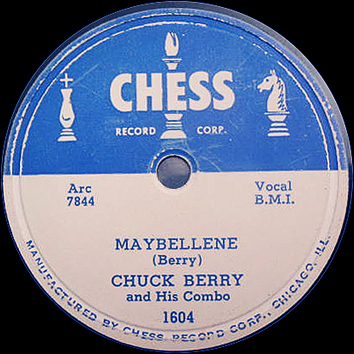
Maybellene — Chuck Berry and His Combo

Original single: Maybellene / Wee Wee Hours (Chess 1604) (1955)

Berry’s national breakthrough distills country-source material into a fast, electric, narrative single. The record is crucial not just for its hit status, but for the way it joins a propulsive guitar figure to a story about speed, desire, and trouble. It sounds like a new commercial language arriving almost fully formed.

Chuck Berry — essential listening 2 2

Roll Over Beethoven — Chuck Berry and His Combo

Original single: Roll Over Beethoven / Drifting Heart (Chess 1626) (1956)

This is one of Berry’s clearest statements of rock and roll self-definition. The song turns musical generational conflict into a punchy, guitar-led manifesto, with Berry framing the new style as something alive, loud, and proudly unscholarly. It captures his gift for making a slogan feel like a complete performance.

Chuck Berry — essential listening 3 3

Johnny B. Goode — Chuck Berry

Original single: Johnny B. Goode / Around and Around (Chess 1691) (1958)

Berry’s most famous recording shows his lead-guitar vocabulary at its most recognizable, with the famous opening figure and the blues-based solo language that followed it. The song’s fiction of the rural guitar hero became a template for rock mythology itself. It remains one of the clearest demonstrations of Berry’s fusion of storytelling and guitar identity.